


The Basic Tools Every Homeowner Needs – And How to Get Them Without Breaking the Bank
By David W. | Mission Ready Father
Knowing the basic tools every homeowner needs is one of the most valuable – and most overlooked – things you can do for your home, your wallet, and your confidence.
The $200 Lesson I Learned the Hard Way
I was in my early twenties, freshly responsible for my first home, and the garbage disposal under my kitchen sink had stopped working. It would hum when I flipped the switch – then nothing. No spin. No grind. Just silence and a sinking feeling.
This was before YouTube. Before you could pull out your phone and find a step-by-step video in 30 seconds. So I did what most people do when they don’t know what they don’t know – I called a repairman.
He showed up, walked to the cabinet under my sink, crouched down, inserted a small tool into a hole at the bottom of the disposal unit, cranked it back and forth a few times, pressed a small red reset button, and walked back to the switch. It worked perfectly.
The whole thing took five minutes.

The bill? Enough to make me feel like I’d been robbed in broad daylight – roughly ten to fifteen times what the fix actually cost in materials. And here’s the part that still stings: that small tool – a 1/4 inch Allen wrench – often comes taped to the disposal unit itself from the factory. The solution to my problem may have been sitting under my sink the entire time.
That day I made a decision. I was never going to be caught unprepared in my own home again.
Why Every Homeowner Needs a Basic Tool Kit
Here’s the truth nobody tells you when you sign the closing paperwork on your first home: your house will constantly need small things fixed. A loose towel rod. A stuck door hinge. A shelf that needs hanging. A leaky fitting under the bathroom sink.
None of these things are complicated. None of them require a professional. But every single one of them requires the right tools – and without them, you have two choices: live with the problem or pay someone else to solve it.
Think about what a basic service call costs in 2026. Most trades charge $75–$150 just to show up at your door before they touch a single thing. The repair itself adds to that. A $10 fix becomes a $150–$200 bill. Multiply that by the dozen small repairs a typical home needs every year, and you’re looking at potentially thousands of dollars leaving your pocket for problems you could have handled yourself in an afternoon.
The right basic tool kit pays for itself the first time you use it.
But the benefits go beyond money – and we’ll get to those.
Before We Start: A Note for Renters and Future Homeowners
If you’re renting right now and thinking “this doesn’t apply to me yet” – stay with me. This section is specifically for you.
You don’t need to own a home to need basic tools. Renters deal with loose cabinet hinges, furniture assembly, hanging pictures, tightening towel rods, and a hundred other small tasks that are easier – and cheaper – with the right tools. More importantly, the habits you build now carry directly into homeownership.
Start your kit now, even a small version of it. When the day comes that you sign on your first home, you won’t be starting from zero.

A Starter Kit for Renters (The Essentials Only):
- A small claw hammer
- A multi-bit screwdriver
- A set of Allen wrenches
- A tape measure
- A pair of slip-joint pliers
That’s it. Five items. You can fit them in a small bag and take them with you when you move. Total cost if bought new: under $50. And we’ll show you how to get them for far less – or free.
How to Build Your Tool Kit Without Spending Much
Before I give you the list, I want to say something that most tool articles skip entirely – you don’t have to buy any of this new.
Here are three ways to build your basic kit for little to nothing:
1. Ask Family Members
This is the first call you should make. Parents, grandparents, aunts and uncles – especially those who owned homes or worked in the trades – almost universally have tools sitting in a garage or basement that they rarely touch anymore. Most are thrilled to pass them on to someone who will actually use them. The tools may even come with a story and some wisdom attached. That’s worth more than the tools themselves.
2. Estate Sales and Garage Sales
Tools are among the best items to buy secondhand. A quality hammer or wrench from a well-known brand doesn’t wear out. It just changes hands. Estate sales in particular are goldmines – you can often find professional-grade tools for pennies on the dollar. Search estatesales.net or gsalr.com for sales in your area.
3. Buy Incrementally
You don’t need everything on this list at once. Start with the five most essential items and add tools as you need them. When you encounter a repair that needs a specific tool – that’s when you buy it. That approach also teaches you why each tool matters, which makes you a better homeowner.
The Basic Tier: Tools Every Homeowner Should Have
These are the basic tools every homeowner needs – recommended from real experience, not a sponsored list. Not a single item on this list is unnecessary. Not one.
I’ll also note where I have brand preferences – and why. My father owned and operated a small electrical company, and I grew up working alongside him. That experience taught me that the difference between a quality tool and a cheap one isn’t just about durability – it’s about the experience of using it. A tool that fits well in your hand, turns smoothly, and holds up under pressure makes every job easier and builds your confidence. Cheap tools do the opposite.
That said, brand matters less on some items than others. I’ll tell you where it does and doesn’t.
1. Small Claw Hammer
What it does: Drives nails, removes nails, and handles light demolition. You’ll use this more than you expect.
Why you need it: Hanging pictures, assembling furniture, minor repairs – the hammer is the most fundamental tool in existence. A 16 oz claw hammer is the right size for general homeowner use – heavy enough to drive a nail efficiently, light enough to control with one hand.
Brand guidance: Mid-range matters here. You don’t need a $60 framing hammer, but avoid the $8 hardware store specials – the handle flex and head balance on cheap hammers are noticeably poor. Estwing and Stanley both make excellent hammers in the $20–$35 range that will last decades.

👉 Stanley 16 oz Rip Claw Fiberglass Hammer on Amazon
2. Multi-Bit Screwdriver / Nut Driver
What it does: Drives Phillips, flathead, and nut driver sizes – multiple tools in one handle.
Why you need it: Virtually every repair in your home involves a screw. Cabinet hinges, outlet covers, furniture assembly, appliance panels, light fixtures – all require a screwdriver. A multi-bit replaces an entire drawer of individual screwdrivers.
Brand guidance: This is where brand matters most on the entire list. I am partial to Klein Tools – and I’ll tell you exactly why. My father ran his electrical company for decades using Klein. Their screwdrivers are built to professional trade standards: the tips fit screw heads precisely, the handles are comfortable under real torque, and they simply don’t wear out. I have Klein screwdrivers that are older than some of my readers.
The Klein 11-in-1 Multi-Bit Screwdriver/Nut Driver is the one I recommend without hesitation. It’s seven sizes in one tool, all sizes allow for easy one-handed driving, the sizes are interchangeable so you always have what you need, and color-coded shaft ends make it easy to identify the size. For a homeowner, this single tool replaces a set of six or more individual screwdrivers.

👉 Klein Tools 11-in-1 Multi-Bit Screwdriver/Nut Driver on Amazon
3. Precision Screwdriver Set (The One Most Lists Miss)
What it does: Drives very small Phillips and flathead screws – the kind that hold toilet paper holders, towel hooks, towel rods, and door hardware in place.
Why you need it: This is the tool most basic tool lists leave off entirely – and it’s the one you’ll reach for constantly. That towel rod that keeps loosening? The toilet paper holder that wobbles every time someone uses it? Those are secured by tiny screws that a standard screwdriver simply can’t grip properly. A precision driver solves every one of those problems.
Brand guidance: I use and recommend Klein Tools here for the same reason I trust their multi-bit screwdriver – the tips are precisely machined, they fit small screw heads without slipping, and they hold up over years of use. If you’re already buying the Klein multi-bit, the Klein precision driver is the natural companion. Don’t buy the ultra-cheap versions of these – poorly machined tips strip small screw heads easily, turning a 2-minute fix into a frustrating ordeal.

👉 Klein Tools Electronic 14-in-1 Screwdriver on Amazon
4. Adjustable Wrench
What it does: Tightens and loosens nuts and bolts of varying sizes without needing a separate wrench for each size.
Why you need it: Under-sink plumbing connections, toilet fittings, appliance connections, furniture bolts – an adjustable wrench handles all of it. One tool covers dozens of nut sizes.
Brand guidance: Crescent is the brand I trust here – it’s the original adjustable wrench brand and still among the best. The smooth jaw adjustment and quality steel on a Crescent wrench is noticeably better than generic alternatives. An 8-inch and a 10-inch cover virtually every homeowners need.
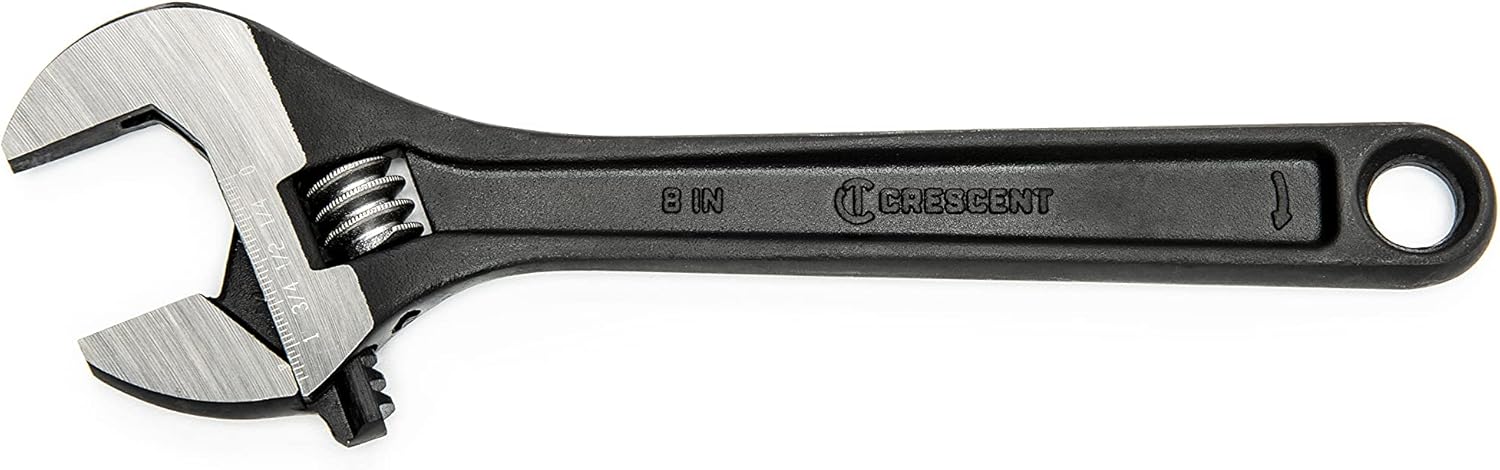
👉 Crescent 8-inch Adjustable Wrench on Amazon
5. Slip-Joint Pliers
What it does: Grips, bends, compresses, and turns things that your hands alone can’t manage.
Why you need it: Plumbing connections, removing stuck caps, bending wire, holding hardware in place while you tighten with the other hand. Pliers are the extension of your grip.
Brand guidance: Channellock is the gold standard for slip-joint pliers – used by plumbers and electricians across the trades. Mid-range is fine here. Avoid the bargain bin.

👉 Channellock Slip-Joint Pliers on Amazon
6. Needle-Nose Pliers
What it does: Reaches into tight spaces, bends wire, and retrieves small items that fingers can’t access.
Why you need it: Electrical work, jewelry repairs, fishing small items out of drains, bending cotter pins – needle-nose pliers handle the delicate, precise work that standard pliers can’t reach.
Brand guidance: Klein again – their needle-nose pliers are built for electrical work and are far superior to generic versions in both grip precision and durability.

👉 Klein Tools Needle-Nose Pliers on Amazon
7. 25 ft Tape Measure
What it does: Measures distances, dimensions, and spaces accurately.
Why you need it: Furniture placement, hanging art, cutting materials, measuring for appliances – you’ll use a tape measure constantly as a homeowner. The 25 ft length handles virtually every room-sized measurement.
Brand guidance: Stanley makes my favorite tape measure – the FatMax line specifically. The blade is wider and stiffer than competitors, which means it extends further without collapsing. That matters when you’re measuring alone and need the tape to stay rigid. The case is durable and the belt clip is solid.

👉 Stanley FatMax 25 ft Tape Measure on Amazon
8. Utility Knife
What it does: Cuts drywall, cardboard, rope, caulk, carpet, packaging – any material that needs a precise cut.
Why you need it: You’ll open boxes with it. Cut caulk lines with it. Score drywall with it. Trim weather stripping with it. A sharp utility knife is surprisingly versatile.
Brand guidance: Mid-range is fine. Stanley and Irwin both make excellent utility knives in the $10–$15 range. Always keep spare blades – a dull utility knife is a frustrating and dangerous one.

👉 Stanley FatMax Utility Knife on Amazon
9. Allen Wrench (Hex Key) Set
What it does: Drives hex socket screws – the kind found on furniture, bicycles, faucet handles, and appliances.
Why you need it: IKEA furniture. Faucet cartridges. Bicycle seat adjustments. Appliance panels. Hex screws are everywhere in a modern home. A full metric and standard set covers all of them.
And yes – a 1/4 inch Allen wrench from this set is exactly what would have saved me that service call twenty years ago. If your garbage disposal ever jams, you insert it into the socket on the bottom of the unit, crank it back and forth until it turns freely, press the small red reset button on the bottom, and you’re done. Most disposals ships with this wrench – it’s silver colored and shaped like a small crank about four inches long – but if yours is missing, a standard 1/4 inch Allen wrench from any set works perfectly. Five minutes. Under $10 in tools. Problem solved.
Brand guidance: Bondhus makes excellent Allen wrench sets with ball-end tips that allow angled driving – worth the slight premium.

👉 Bondhus Allen Wrench Set on Amazon
10. Torpedo Level
What it does: Tells you whether a surface, shelf, or hanging object is perfectly level or plumb.
Why you need it: Every shelf you hang, every picture frame you mount, every appliance you install – the torpedo level tells you whether it’s straight. Nothing looks more amateur than a crooked shelf. Nothing looks more professional than one that’s perfectly level.
Brand guidance: Mid-range is fine here. Empire and Stanley both make reliable torpedo levels in the $10–$20 range.

👉 Stanley Torpedo Level on Amazon
11. Flashlight
What it does: Illuminates dark spaces – under sinks, inside cabinets, in crawl spaces, behind appliances.
Why you need it: You cannot fix what you cannot see. A good flashlight is non-negotiable for any home repair that involves plumbing, electrical, or anything in a confined space.
Brand guidance: LED flashlights have transformed this category. Maglite and Streamlight both make excellent options. For homeowner use, a mid-size LED flashlight with strong output and reliable battery life is all you need. Headlamps are also worth considering – having both hands free when you’re under a sink is invaluable.

👉 Streamlight LED Flashlight on Amazon
12. Stud Finder
What it does: Locates the wooden studs behind your drywall – the structural members your shelves, TVs, and heavy items need to be anchored into.
Why you need it: Drywall anchors alone will not hold a heavy shelf, a large mirror, or a mounted TV securely over the long term. Studs will. A stud finder takes the guesswork out of finding them – and it takes about thirty seconds to use. This is a very nice addition to your basic kit that pays for itself the first time you hang something heavy.
Brand guidance: Franklin Sensors makes the most reliable consumer stud finders – the ProSensor model is particularly accurate and eliminates the false readings that plague cheaper units.

👉 Franklin Sensors ProSensor Stud Finder on Amazon
The Benefits Beyond the Money
We’ve talked about what these tools cost and what they save you. But I want to spend a moment on what they give you that has nothing to do with money.
Competence and Confidence
There’s a specific feeling that comes from fixing something yourself for the first time – a quiet pride in your own capability. It doesn’t matter whether it’s a leaky faucet or a loose door hinge. The knowledge that you handled it – that you didn’t have to wait for someone else or write a check – builds something in you that carries far beyond home repair. Competent people know they can figure things out. That confidence shows up everywhere in life.
Independence
A home you can maintain is a home you control. Service calls get scheduled on someone else’s timeline. When you have the tools and the knowledge, you work on your own schedule, at your own pace, for free.
The Parent-Child Opportunity
If you have children – or will someday – your tool kit becomes one of the most powerful teaching tools you own. Letting a child hand you tools, help measure, hold a flashlight, or tighten a screw alongside you is about far more than home repair. It’s about teaching them that they are capable. That problems have solutions. That figuring things out is something to lean into rather than run from. Some of my most valuable memories with my own father happened in exactly those moments – standing next to him, watching him work, learning without knowing I was learning.
That gift costs you nothing except the time to invite them in.
What’s Coming Next
This is Part 1 of a three-part series on building your homeowner tool kit.
In Part 2 – The Intermediate Tool Kit – we’ll cover the tools that take you from handling basic repairs to tackling real projects: power tools, measuring equipment, and the additions that expand what’s possible in your home.
Start here, get comfortable with what you have, and we’ll build from there together.
The Bottom Line
You don’t need a garage full of tools to take care of your home. You need the right tools – quality over quantity, every time.
Start with this list. Ask a family member first. Check an estate sale. Buy incrementally. And when you do buy new, invest in quality brands that will outlast you.
Your home is likely the largest investment you’ll ever make. Treating it that way – showing up for it with the right tools and the willingness to learn – is one of the most Mission Ready things you can do.
If you want to know more about where this blog comes from and why I started it, the “About page” tells the full story.
– David W.
Mission Ready Father participates in the Amazon Associates program. If you purchase through the links in this post, I may earn a small commission at no extra cost to you. I only recommend products I personally use or would confidently recommend to a family member.
Discover more from The Mission Ready Father
Subscribe to get the latest posts sent to your email.
